
Archipelago Adobe
Archipelago Adobe
Ronald Rael
Ronald Rael
Imagine a large robot mounted on a mobile trailer, methodically depositing layers of mud and straw—much like a swallow building its nest—to construct architectural forms as large as small homes. These robotic additive manufacturing structures are more than shelters; they are experimental spaces that explore the material, spatial, and sensory potential of earthen construction. Each structure emerges as a proto-architectural exploration, shaping walls that capture the interplay of light and shadow, framing views of the sky and landscape, and forming narrow passageways that lead into expansive enclosures. These spaces invite heightened sensory engagement—places for repose, fire, water, darkness, light, and storytelling—where the body and the land exist in dialogue. At its core, this project explores the intersection of technology, storytelling, and cultural reaffirmation through large-scale, robotic adobe construction.
While earthen architecture has deep historical and cultural significance in many regions, both in urban and rural areas, the tradition is rapidly disappearing in favor of industrial materials. This project reclaims and reinterprets that legacy, showing how emerging technologies can not only preserve but advance the possibilities of earthen construction. Spanning multiple sites, the project forms an “archipelago” of experimental structures across geographies where adobe has historically been vital. Each site becomes both a production and engagement point, inviting local communities, students, architects, and the public to experience and interact with the work. The project directly connects participants to adobe as a historical land-based practice, deepening their understanding of its cultural significance, while also introducing a forward-thinking perspective on robotics and computation in architecture. The project demonstrates how these technologies can extend, rather than replace, traditional knowledge.
A key aspect of this project is education and accessibility. Robotics, computational design, and digital fabrication are largely inaccessible in rural regions, yet they are shaping the future of construction. This project bridges that gap. Through on-site workshops, demonstrations, and public engagement, participants will witness robotic construction firsthand and learn about its potential applications in sustainable architecture. Young audiences, in particular, will have the chance to engage with both adobe and robotics, connecting the past and future through hands-on experience. Ultimately, the project will manifest as a series of built experiments—evolving explorations of form, texture, and inhabitation.
These structures will act as both autonomous architectural objects and provocations, challenging contemporary ideas about materiality, labor, and the role of emerging technology in architecture. They ask: How can robotics reinvigorate land-based practices rather than replace them? How can architecture engage the senses in ways industrialized construction no longer does? And what new aesthetic, spatial, and social possibilities arise when we reimagine earth—humankind’s oldest building material—through the lens of new technology? By merging traditional craft with advanced fabrication, this project doesn’t just recreate adobe structures of the past; it redefines them for the future, creating spaces that are deeply rooted in place yet radically forward-thinking.
Architecture & Design, Craft, Technology, Visual Arts
2026
About Ronald Rael
Antonito, CO
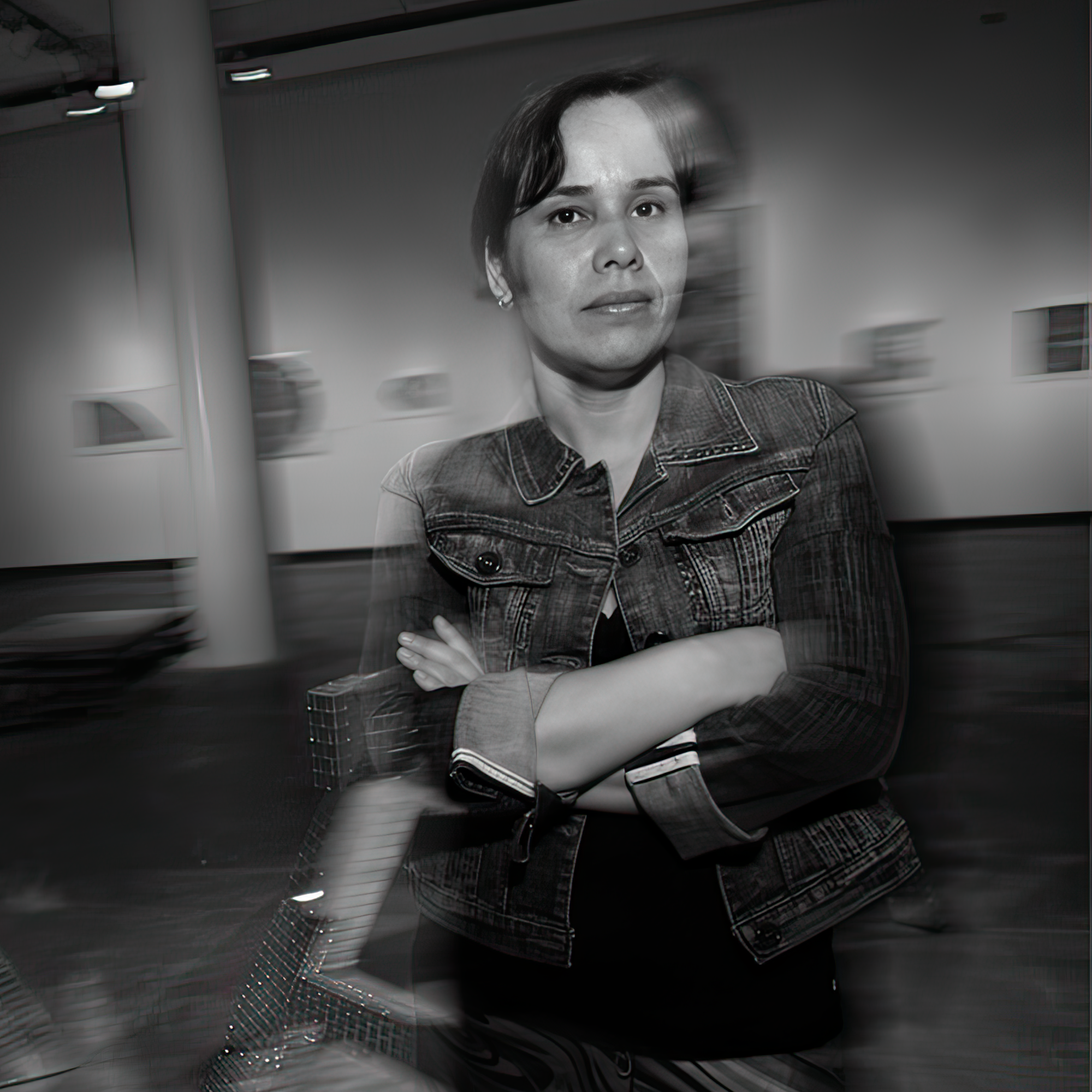
Ronald Rael’s creative work transcends the boundaries between architecture, art, technology, land-based practices, and social justice. A writer, entrepreneur, advocate for human rights at the U.S.–Mexico border, software creator, inventor of novel materials, and designer, he approaches each project as an applied research endeavor. His studio gained international recognition for the Teeter Totter Wall, a guerrilla installation uniting families across the U.S.–Mexico border. He co-founded FORUST, a startup that uses 3D printing to transform wood waste into beautiful products, and has pioneered robotic construction of raw earthen buildings. Rael’s work is part of permanent collections at MoMA, Cooper Hewitt, London Design Museum, LACMA, SFMOMA, and the Renwick Smithsonian American Art Museum. He serves as Chair of the Department of Art Practice and Eval Li Memorial Chair in Architecture at UC Berkeley.